

Let’s be real for a second. You can go to the doctor, get a “perfect” fasting blood sugar reading, and walk out thinking everything is fine. Meanwhile, your blood vessels might be taking a beating every single time you eat lunch.
For a long time, the whole conversation around diabetes and sugar has been stuck on two numbers: what your sugar does when you wake up (fasting) and that 3-month average called A1C. But the science is shifting. It turns out the real damage doesn’t happen when you’re sleeping. It happens right after you eat.
This is the “Postprandial” spike. It’s that hour or two after a meal when your body is scrambling to handle the fuel you just gave it. If you’ve ever felt like you need a nap at 2 PM, you’ve probably felt this happen.
The “Aha!” Moment: Most people miss the single most important number: your sugar level 1 hour after a meal. Doctors usually check the 2-hour mark, but the 1-hour spike is like the canary in the coal mine. It warns you about trouble years before a Type 2 diagnosis ever shows up on a chart.
Key Takeaways
- The 1-Hour Rule: If your metabolism is healthy, you rarely go above 140 mg/dL, even after a big meal.
- The Comeback: By hour 2, you should be back under 140 mg/dL (under 120 is even better).
- The “Pizza Effect”: Fatty foods are tricky—they can push your sugar spike back to 3 or 4 hours after eating.
- The Danger Zone: If you are consistently seeing blood sugar 130 after eating (specifically at the 2-hour mark), take it seriously. It’s an early warning sign.
The Golden Timeline: Blood Sugar 1, 2, 3, and 4 Hours After Eating
Random testing is just guessing. You need a map. You need to know exactly when to test to see how your body is actually handling diabetes and sugar.
Below is the “Golden Timeline.” We’ve broken this down into what doctors use to diagnose you vs. where you actually want to be for optimal health.
Table 1: The Post-Meal Blood Sugar Timeline
| Time Since Meal | Optimal (Non-Diabetic) | Pre-Diabetic Range | Diabetic Target (ADA Goal) |
|---|---|---|---|
| Fasting | 70–99 mg/dL | 100–125 mg/dL | 80–130 mg/dL |
| 1 Hour After Eating | 90–130 mg/dL | 140–190 mg/dL | < 180 mg/dL |
| 2 Hours Post Meal | 90–110 mg/dL | 140–199 mg/dL | < 180 mg/dL |
| 3 Hours After Eating | 70–100 mg/dL | 120–140 mg/dL | < 140 mg/dL |
| 4 Hours After Eating | Back to Fasting | 100–120 mg/dL | < 120 mg/dL |
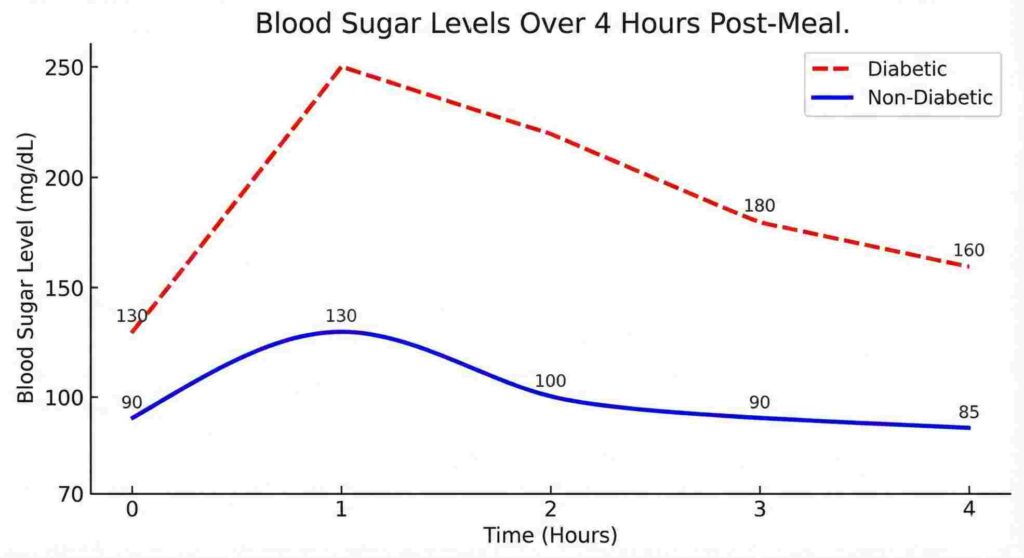
Phase 1: The Spike (0 to 60 Minutes)
Normal Blood Glucose Levels 1 Hour After Eating
Think of the 60-minute mark as a stress test for your body. When you eat carbs, they turn into glucose fast. If your metabolism is working right, your pancreas releases a huge burst of insulin immediately—called the “First Phase” response—to catch that sugar before it floods your system.
If you are checking your sugar level 1 hour after meal, you want to see it under 130 mg/dL. Maybe 140 mg/dL if it was a huge meal.
But if you see 160, 180, or 200 mg/dL here? That “First Phase” response might be lagging. This is often the very first sign that something is wrong, even if your fasting numbers look perfect.
Phase 2: The Recovery (2 Hours Post Meal Blood Sugar)
This is the standard checkup point. By now, the heavy lifting should be over.
- For Non-Diabetics: Your body should have cleared most of that sugar. You should be pretty close to where you started.
- For Diabetics: The American Diabetes Association (ADA) says stay under 180 mg/dL. However, a lot of functional medicine experts will tell you to aim tighter—closer to 140 mg/dL—to really protect your organs.
What about “Blood Sugar 130 After Eating”?
People ask this all the time. If you test 130 mg/dL:
- 1 Hour After: Great job. You’re handling the meal well.
- 2 Hours After: Good, but it shows your insulin is still working on it.
- Fasting: That’s high. You need to see a doctor.
Phase 3: The Tail End (3 & 4 Hours After Eating)
Here is where things get weird, and standard advice usually drops the ball.
3 Hours After Eating Blood Sugar Levels
Why on earth would your sugar be high three hours later?
- Gastroparesis: This is a complication where the stomach empties too slow. Digestion gets delayed.
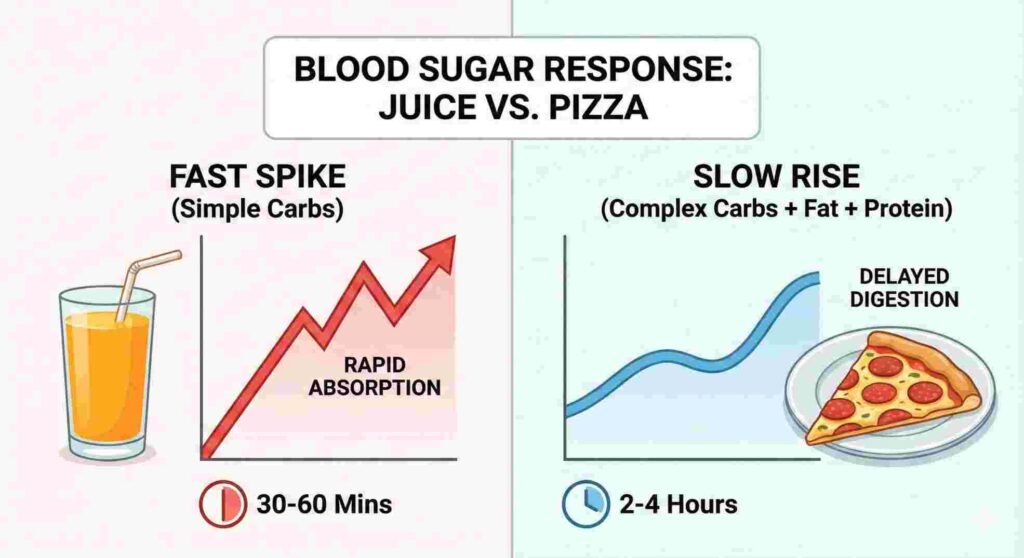
- The “Pizza Effect”: Meals heavy in fat and protein (think pizza, steak, or creamy pasta) put the brakes on digestion. You might not see a spike at hour 1 or 2. Instead, you get a slow creep that peaks at 3 hours after eating blood sugar levels.
Blood Sugar 4 Hours After Eating
By hour 4, you should basically be back to baseline (70–90 mg/dL). If you’re still high here, your background insulin might be too low, or you’re dealing with some heavy insulin resistance.
Table 2: The “Pizza Effect” vs. Simple Carbs
| Food Type | Peak Sugar Time | 1 Hour Level | 3-4 Hours Level |
|---|---|---|---|
| Soda / Candy (Simple Carbs) | 30–45 mins | Very High Spike | Crash (Hypoglycemia) |
| Oatmeal / Fruit | 60 mins | Moderate High | Back to Normal |
| Pizza / Burger (High Fat+Carb) | 180–240 mins | Low/Normal | Unexpected High |
How to Flatten the Curve (Without Starving)
You don’t have to stop eating to fix these numbers. Just changing how you eat can drop your 2 hours post meal blood sugar dramatically.
- Don’t Eat “Naked” Carbs: Never eat carbs alone. Always pair them with protein, fat, or fiber. It slows everything down.
- Order Matters: Eat veggies first. Then protein. Save the starches (rice, potatoes) for last. Believe it or not, just switching the order can lower the spike by huge margins.
- The 10-Minute Walk: Move your body for 10 minutes after a meal. It wakes your muscles up to soak up glucose so you don’t need as much insulin.
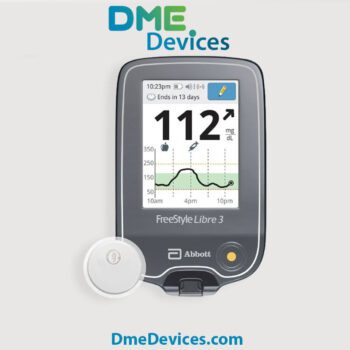
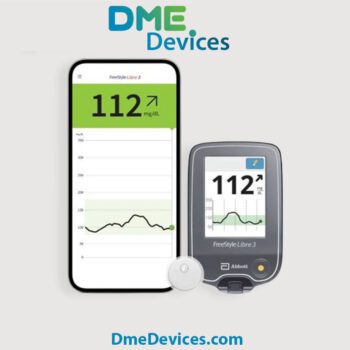
- See the Full Picture: You can’t manage what you don’t measure. Finger pricks are just a snapshot. To see the whole movie—including that sneaky 3-hour spike—you might want a Continuous Glucose Monitor (CGM).
Pro Tip: If you want to see exactly what’s happening minute-by-minute, check out the Freestyle Libre 3 Plus Buy Now to start seeing the data your doctor misses.
Table 3: Blood Sugar Management Tools
| Tool | Pros | Cons | Best For |
|---|---|---|---|
| Finger Prick (Glucometer) | Cheap, easy to find | Painful, misses the “in-between” | Occasional checks |
| A1C Test | 3-month average | Misses daily highs/lows | Long-term diagnosis |
| CGM (Continuous Monitor) | Real-time data, alerts you | Can be pricey | Complete control |

Conclusion
Managing diabetes and sugar isn’t just about saying no to cookies; it’s about timing. The difference between a healthy future and chronic issues often hides in the numbers between your doctor visits.
Focus on that sugar level 1 hour after meal. Make sure you return to baseline by hour 3 or 4. That is how you take control of your energy and your health. Don’t guess—test.
Ready to see what your blood sugar is doing right now?












What is a dangerous blood sugar level 1 hour after eating?
generally, anything above 200 mg/dL at any time is a red flag for diabetes or uncontrolled hyperglycemia. If you see numbers above 180 mg/dL consistently, talk to your doctor.
Why is my blood sugar 130 after eating 4 hours later?
his usually means you had a high-fat, high-protein meal (which delays digestion) or your background insulin needs a tweak. Your body is struggling to clear that last bit of glucose.
Is 150 high for 1 hour after eating?
For a non-diabetic, 150 mg/dL is a bit high but can happen if you ate a lot of carbs. For a diabetic, staying under 180 mg/dL is the goal, so 150 mg/dL is often considered a “win.”
Does drinking water lower blood sugar?
Yes. When your sugar is high, your body tries to flush the excess out through urine. Water helps that process and rehydrates your blood, which can slightly lower the glucose concentration.
What is the normal range for 3 hours after eating?
Ideally, you should be back between 70–100 mg/dL. If you’re stuck around 120–140 mg/dL, it points to mild insulin resistance.




Write a comment
Your email address will not be published. All fields are required